

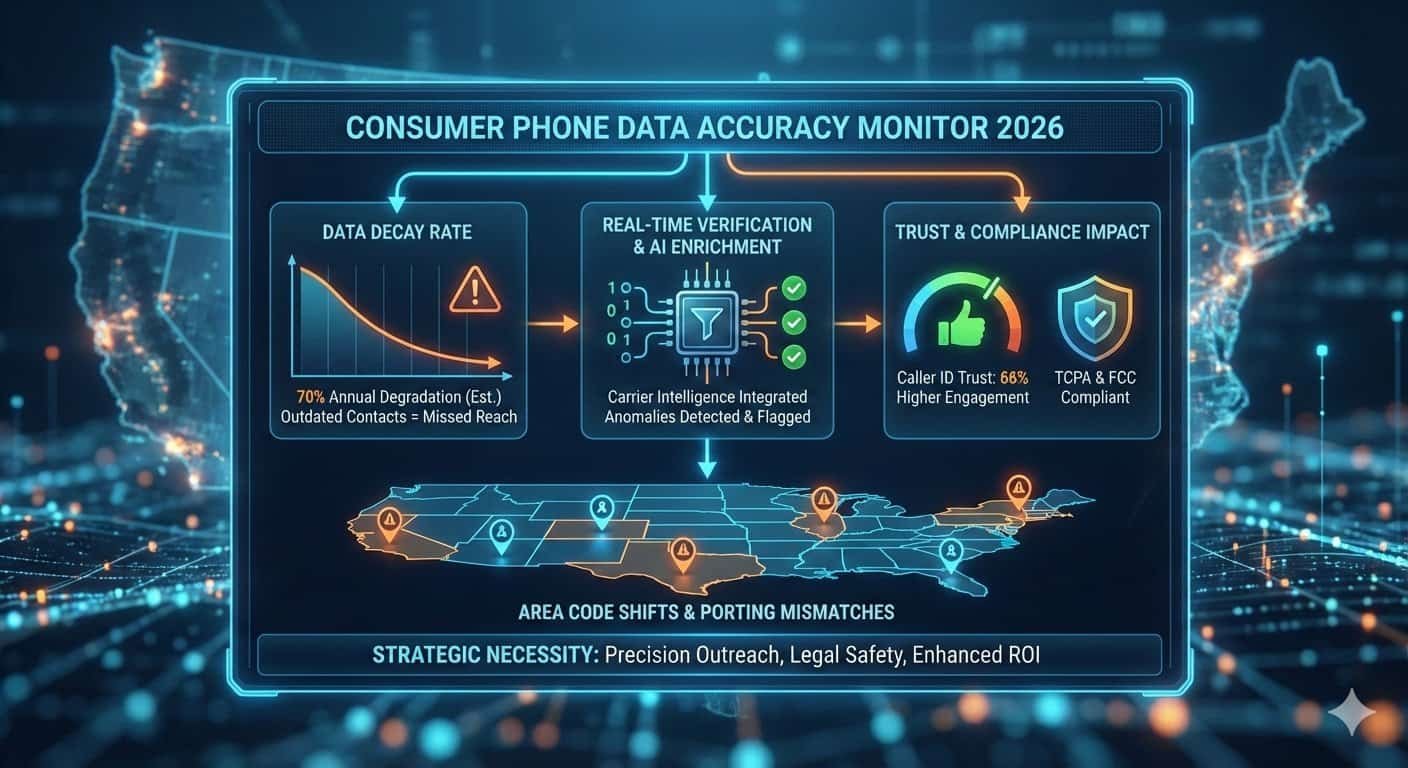
In today’s marketing scene, phone data accuracy has moved far beyond a backend concern — it’s now a cornerstone of effective campaigns. As consumer behavior shifts toward mobile-first interactions, regulations tighten, and technology continues to advance, mastering phone number validation and data quality is no longer optional for U.S. marketers.
Why Getting Phone Data Right Has Never Been More Critical
The consequences of inaccurate phone data go well beyond wasted budgets. Marketers who overlook data quality put themselves at risk of TCPA regulatory violations, reputational damage, and poor return on investment. Specifically, the fallout can include:
- Multi-million dollar compliance fines stemming from TCPA breaches
- Squandered ad spend spent targeting numbers that no longer exist
- Frustrating customer experiences caused by calls reaching the wrong people
- Declining conversion rates when genuine prospects simply can’t be reached
The path forward requires treating phone data quality as a strategic discipline — one that weaves together technology, compliance, and consumer trust.
Trend 1: The Growing Crisis of Phone Data Decay
Phone numbers go stale quickly — far more quickly than most marketers appreciate. Industry data suggests that contact databases can degrade by 20 to 70 percent annually if left unattended. Numbers get disconnected, subscribers switch carriers, area codes shift, and mobile phones increasingly displace traditional landlines.
What does this mean in practice? If you acquire 10,000 consumer phone records today, as many as 3,000 to 7,000 of those entries could be outdated, disconnected, or reassigned within just 12 months. Every bad number translates to lost sales team time, lower response rates, compliance exposure, and a deteriorating reputation with carriers.
The fix: Forward-thinking marketers are trading static, one-time database purchases for real-time phone validation solutions that verify numbers upon entry, flag disconnections instantly, track carrier changes, and keep records current automatically. At a minimum, phone data should be validated quarterly — monthly for high-volume operations.
Trend 2: Caller ID Accuracy and Its Direct Impact on Answer Rates
Consumer trust sits at the heart of whether your calls get answered at all. Research shows that nearly two-thirds of U.S. consumers are more inclined to pick up a call when they recognize and trust the caller ID information displayed.
However, even legitimate businesses can be tagged as spam if their data doesn’t align with carrier records, if calling patterns look suspicious, or if number reputation scores are low. To protect answer rates, marketers should:
- Cross-check phone numbers against verified carrier databases
- Register business numbers with CNAM (Caller ID Name) services
- Adopt branded caller ID through industry-recognized verification programs
- Actively monitor number reputation scores
- Deploy STIR/SHAKEN authentication to confirm call legitimacy
Combining accurate phone data with robust caller ID verification creates a powerful foundation for campaign performance.
Trend 3: Number Portability and the Area Code Illusion
An area code alone is no longer a reliable indicator of where a consumer lives or operates. Consumers freely port numbers when they relocate, new overlay area codes regularly enter service, VoIP and mobile technologies have severed the geographic link between numbers and locations, and demographic shifts are constantly reshaping area code populations.
When geographic targeting relies solely on area codes, campaigns miss their mark — regional offers reach the wrong audiences, time-zone scheduling goes awry, and local compliance requirements may inadvertently be violated.
The smarter approach: Sophisticated marketers now use carrier intelligence services that deliver real-time number porting detection, precise location data beyond area codes, carrier identification, and line type verification (mobile versus landline), turning phone data into a precision targeting asset.
Trend 4: TCPA Compliance and the Quality Imperative
The Telephone Consumer Protection Act is evolving, and recent legal developments make clear that data quality — not just data volume — is under scrutiny. In 2026, marketers face stricter consent documentation requirements, steeper penalties for contacting wrong numbers, more aggressive “Do Not Call” list enforcement, and heightened oversight of automated dialing systems.
The financial stakes are real: individual TCPA violations can cost between $500 and $1,500, with class-action suits potentially reaching into the millions. Beyond fines, enforcement actions and brand reputation damage can be long-lasting.
Accurate phone data functions as legal protection. Verified contact details reduce wrong-number risks, consent records tied to validated numbers are more defensible, routine data cleansing removes DNC-listed entries, and documented validation procedures hold up under compliance audits. When selecting a phone append partner, prioritize providers with a clear commitment to TCPA compliance and consent verification.
Trend 5: AI-Powered Validation and Data Enrichment
The technology underpinning phone data validation has undergone a quiet revolution. Marketers today have access to tools that would have seemed extraordinary just a few years ago:
- Real-time validation APIs that instantly check line status, detect disconnections, spot recently ported numbers, and flag suspicious formats
- AI-driven data matching that predicts number validity with 95%+ accuracy, surfaces anomalies conventional tools overlook, learns from campaign history, and suggests the most effective contact timing and channels
- Carrier intelligence integration that combines live carrier database feeds, reputation scoring, spam-likelihood prediction, and channel optimization (voice versus SMS)
Marketers who have embraced these tools report contact rate improvements of 30 to 50 percent, compliance risk reductions of 25 percent, and ROI gains of up to 40 percent. The lesson: invest in validation technology before investing in new contact lists.
Best Practices for Sustaining Phone Data Quality
1. Think Real-Time, Not Annual
Every phone number entering your CRM should be validated at the point of entry. Automated monthly cleansing, risk-flagging for manual review, and proper archiving of invalid records should become standard procedure.
2. Diversify Your Data Sources
Relying on a single provider introduces unnecessary risk. Cross-reference multiple append services, run carrier lookups, incorporate consumer-permissioned data, and build redundancy into mission-critical campaigns.
3. Tier Your Data by Validation Status
Not all records deserve equal treatment. Freshly validated numbers belong on high-priority call lists; unvalidated numbers should be verified before use; disconnected or invalid entries should be suppressed or removed entirely.
4. Layer in Carrier Intelligence
Go beyond area codes by enriching your database with current carrier data, line type classification, porting history, and geographic accuracy verification.
5. Document Everything for Compliance
Maintain thorough records of when and how numbers were validated, the consent status of each contact, data acquisition sources and dates, and your DNC scrubbing history.
6. Track the Metrics That Matter
Key performance indicators worth monitoring include contact rate, percentage of invalid numbers, spam label frequency, compliance incident rate, and cost per valid contact.
How Phone Append Services Address These Challenges
Phone appending enriches your existing customer database with verified, up-to-date phone numbers — a smarter alternative to purchasing cold lists. Professional append services offer:
- ✅ High match accuracy, typically 90% or better with verified data
- ✅ Built-in TCPA compliance, with supporting documentation
- ✅ Better ROI compared to purchased contact lists
- ✅ Real-time number validation before delivery
- ✅ Carrier intelligence including line type and carrier identification
Phone appending is especially valuable when reconnecting with lapsed customers, expanding contact coverage for your existing database, or when compliance requirements demand verified data.
Final Thoughts: Turning Data Accuracy Into a Competitive Edge
For U.S. marketers navigating 2026, phone data accuracy is a business imperative. It’s what separates campaigns that generate results from campaigns that drain budgets, invite legal risk, and erode brand trust.
Key reminders
- Contact databases decay at a rate of 20–70% per year without upkeep
- Trusted caller ID can boost answer rates by up to 66%
- Poor-quality data is a leading driver of costly TCPA violations
- AI-powered validation tools are now a competitive necessity
- Ongoing validation consistently outperforms one-time data purchases
Your action plan:
- 📌 Conduct an honest audit of your current phone database
- 📌 Integrate real-time validation into your data workflow
- 📌 Engage a reputable, compliance-focused phone append provider
- 📌 Build data quality awareness across your marketing team
- 📌 Establish ongoing performance monitoring
Accurate phone data isn’t just a technical upgrade — it’s a strategic investment that pays dividends in campaign efficiency, legal safety, and long-term customer relationships.